
Introduction
Every drummer faces this critical decision. Choosing 2b or 7a drumsticks determines your entire playing experience. The choice goes far beyond personal preference. It involves physics, technique, and musical genre. Understanding these factors helps you make informed decisions.
Drumsticks serve as the primary connection between you and your instrument. The wrong choice limits your expression. The right choice unlocks new possibilities. This guide breaks down the science behind these two popular models.
CUSTEAM crafts both 2B and 7A drumsticks with precision. Each design serves specific musical needs. We will explore how these differences affect your playing.
Understanding Drumstick Specifications
What Do the Numbers and Letters Mean?
Drumstick naming follows traditional industry standards. Numbers indicate weight and diameter. Letters refer to intended use. The system originated from early 20th-century manufacturing.
The “A” series originally served orchestra players. The “B” series targeted band musicians. Today, these designations persist with modified meanings. Most manufacturers follow similar sizing conventions.
2B Drumstick Core Characteristics
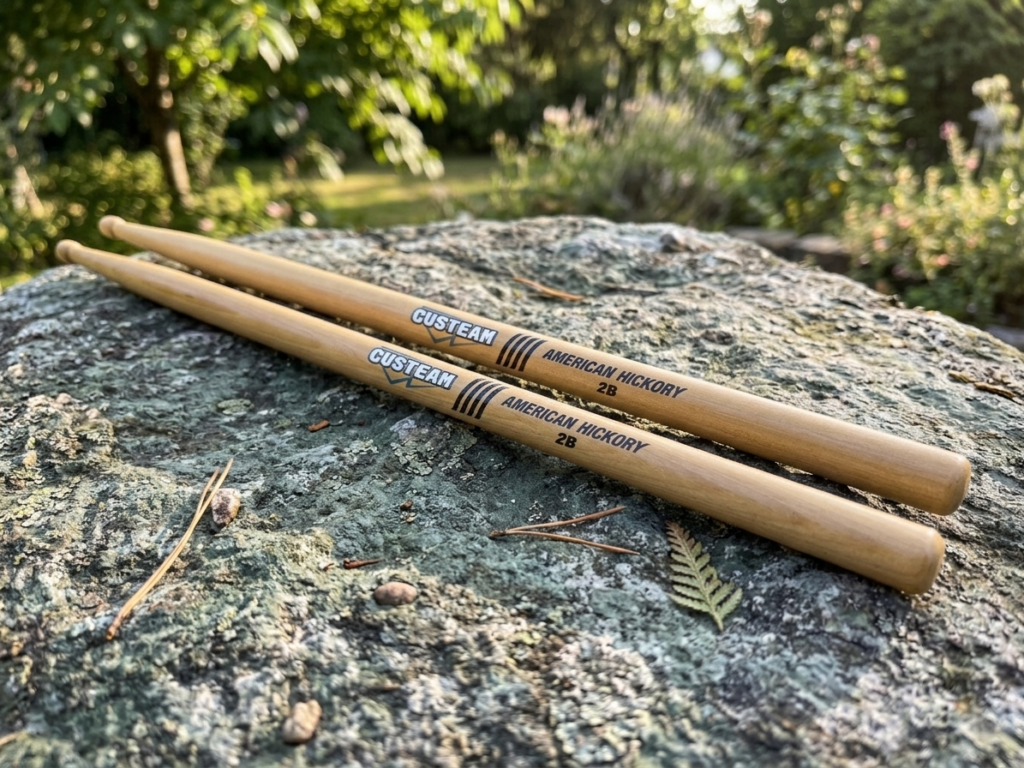
2B drumsticks represent the heavier end of the spectrum. They feature a larger diameter and more wood mass. Drummers often associate them with power and volume.
The typical 2B measures 0.630 inches in diameter. Length usually ranges from 16 to 16.75 inches. The extra weight delivers stronger impact with less effort. Rock and metal drummers frequently prefer this model.
CUSTEAM 2B models use dense hickory or maple construction. Each undergoes strict quality control. The design prioritizes durability for heavy hitters.
7A Drumstick Core Characteristics
7A drumsticks represent the lighter, narrower option. They excel in situations requiring finesse and speed. Jazz and acoustic players often favor this design.
Standard 7A diameter measures approximately 0.540 inches. Length typically falls between 15.5 and 16 inches. The reduced weight enables faster stick movement. Controlled dynamics become much easier.
CUSTEAM 7A drumsticks balance lightness with durability. We use selected hardwoods for consistent performance. Each stick undergoes precision balancing.
The Physics Behind Your Choice
Weight and Momentum Principles
Heavier sticks generate more momentum per stroke. Newton’s laws directly apply here. Mass multiplied by velocity equals force. A 2B moving at same speed as 7A hits harder.
However, extra weight requires more physical effort. Fatigue becomes a factor during long sessions. Your arm muscles work harder with each stroke. The trade-off between power and endurance matters greatly.
Hypothetical Scenario: A metal drummer plays a two-hour set. Using 2B sticks produces massive sound. By the final songs, arm fatigue noticeably reduces accuracy.
Surface Area and Contact Patch
Larger diameter means more contact surface on drumheads. This affects tone and volume simultaneously. The 2B creates a broader, warmer sound. The 7A produces focused, articulate attack.
The contact patch also influences rebound characteristics. A larger surface area compresses the drumhead differently. This changes how the stick bounces back. Your playing technique must adapt accordingly.
Balance Point Differences
Every drumstick has a unique balance point. This refers to the center of gravity along the shaft. Manufacturers position this point strategically.
2B sticks often have balance points closer to the tip. This enhances power delivery during downstrokes. 7A sticks sometimes feature balance points further back. This facilitates faster rebound and wrist control.
CUSTEAM engineers calculate balance points for each model precisely. Every production run maintains consistent specifications. Drummers notice this consistency immediately.
Genre-Specific Applications
Rock and Metal: Where 2B Excels
Heavy music demands power and projection. 2B drumsticks deliver exactly this. Thick shafts withstand relentless rimshots. The weight helps cut through amplified instruments.
Modern metal drummers often combine 2B with double bass techniques. The sticks handle fast single-stroke rolls reasonably well. Volume becomes the priority over subtlety. Venues without proper mic’ing benefit especially.
The following table summarizes stick preferences across different rock subgenres.
| Music Subgenre | Preferred Stick | Primary Reason | Typical Volume Level |
|---|---|---|---|
| Thrash Metal | 2B | Power, durability | Extreme |
| Classic Rock | 2B or 5B | Balanced approach | High |
| Alternative Rock | 5A or 2B | Versatility | Medium-High |
Table 1: Rock subgenre stick preferences. Choosing 2b or 7a drumsticks depends heavily on specific subgenre requirements.
Jazz and Acoustic: 7A Territory
Jazz drumming emphasizes dynamics and touch. 7A sticks excel in these areas. Brushes often pair with 7A for traditional jazz settings.
The narrow shaft allows intricate finger control. Drummers execute complex cymbal patterns with ease. Lower volume settings work perfectly for intimate venues. Studio recording sessions frequently use 7A models.
Hypothetical Scenario: A jazz trio plays a small restaurant gig. Using 7A sticks, the drummer maintains perfect volume balance. Switching to 2B would overpower piano and bass completely.
Hybrid Genres: The Middle Ground
Many drummers play multiple musical styles. Choosing 2b or 7a drumsticks becomes difficult in these cases. Hybrid genres create interesting challenges.
Funk music sits between rock and jazz. Some funk drummers use 7A for ghost notes. Others prefer 2B for solid backbeats. The choice ultimately depends on venue size and band configuration.
Playing Technique Considerations
Grip Style Compatibility
Your grip style influences stick choice dramatically. Traditional grip works exceptionally well with 7A sticks. The narrow diameter fits comfortably between fingers. Matched grip accommodates both models effectively.
German grip favors heavier sticks like 2B. French grip naturally pairs with lighter 7A. American grip handles either model comfortably. Understanding your grip mechanics prevents injury.
Wrist vs. Arm Playing
Wrist-dominant players achieve better results with 7A. The light weight facilitates rapid movement. Arm-dominant players generate more power with 2B. Their technique compensates for extra weight.
Many intermediate drummers develop mixed approaches. They use wrist for finesse sections and arm for power parts. Transitioning between 2B and 7A becomes necessary for versatility.
CUSTEAM offers custom weight options for serious players. We can adjust specifications to match your technique. Contact our customization team for personal consultations.
Endurance Factors
Playing stamina decreases with heavier sticks. A 2B causes muscle fatigue noticeably faster than 7A. Professional drummers account for this in their practice routines.
Your physical conditioning matters significantly. Regular strength training improves endurance with heavier sticks. Conversely, finger dexterity practice enhances 7A performance. Most players benefit from alternating stick weights during practice.
Material Considerations
Hickory Construction
Both 2B and 7A come in hickory variants. This wood offers excellent durability and flex. It absorbs shock better than most alternatives. Hickory represents the industry standard.
CUSTEAM hickory comes from sustainable American forests. Each stick undergoes proper curing processes. The result is consistent density across production runs.
Maple Construction
Maple creates lighter sticks for the same diameter. 2B maple feels closer to 5B hickory in weight. 7A maple works for extremely delicate playing.
The trade-off involves reduced durability. Maple sticks break more easily under heavy impact. However, they produce warmer tones than hickory. Studio drummers often prefer maple for recording purposes.
| Material | 2B Weight | 7A Weight | Durability Rating | Tone Characteristic |
|---|---|---|---|---|
| Hickory | ~65g | ~50g | 9/10 | Bright, focused |
| Maple | ~55g | ~42g | 6/10 | Warm, dark |
| Oak | ~75g | ~58g | 10/10 | Cutting, harsh |
Table 2: Material comparison for standard stick models. Choosing 2b or 7a drumsticks involves material selection as well.
This comparison demonstrates how material choice significantly impacts both weight and durability characteristics when choosing 2b or 7a drumsticks.
Customization Options at CUSTEAM
Modified 2B Options
Not all drummers fit the standard 2B profile. Some want extra length without added diameter. Others prefer slightly reduced weight. CUSTEAM accommodates these requests through a range of modifications that keep the core 2B feel while tailoring specific dimensions to your playing style.
Available options include extended lengths up to 17 inches for drummers who need extra reach, reduced diameter variants down to 0.600 inches for players who want 2B power with a more manageable grip, alternative tip shapes that shift cymbal attack characteristics, and custom grip coatings that improve control during intense performances. Each modification changes stick performance in measurable ways. Our team guides you through the available combinations and tests every custom order for balance consistency before shipping.
Modified 7A Options
7A customization focuses mainly on control enhancements. Some drummers want slightly increased diameter to add a touch of weight without leaving the 7A family. Others request specialized tip materials that change how the stick interacts with cymbals and ride surfaces.
Common modifications include grip-enhancing finishes that reduce slippage during sweaty performances, nylon or wood tip variations for different cymbal articulation, extended taper designs that shift the balance point further back for faster rebound, and weight-matched pairs calibrated to within 0.5 grams. We maintain our quality standards for all custom orders, and each stick receives the same inspection process regardless of modification level. Delivery typically takes 7-10 business days.
Making Your Decision
Assessment Questions
Before making your final decision between 2b or 7a drumsticks, take a moment to reflect on your specific needs and circumstances. Consider your musical context, physical requirements, and performance environment. The following questions can help guide your thinking:
- What genre do I play most frequently?
- Do I prioritize power or finesse?
- What is my typical venue size?
- How long are my performance sets?
- Do I experience wrist or arm fatigue?
Honest answers to these questions will help reveal your actual needs. Many drummers discover they overestimated their power requirements. Others realize they need more durability than 7A provides.
Try Before You Commit
Whenever possible, test both stick types. Visit a music store with practice pads. Play your typical patterns with each model. Notice the differences in feel and response.
CUSTEAM offers trial packs for serious buyers. We send sample sticks for evaluation before your full purchase. This eliminates guesswork from your decision process.
Building Your Stick Collection
Most professional drummers own multiple stick types. They use 2B for loud rock gigs. They switch to 7A for jazz sessions. Many keep 5A as their all-around option.
Your collection should match your performance diversity. Start with your primary need. Add complementary types as your budget allows. CUSTEAM offers quantity discounts for multiple model orders.
Final Recommendations
For drummers playing heavy music consistently, choose 2B. The power and durability justify the extra weight. Your sound will cut through loud band mixes effectively.
For drummers focused on dynamics and speed, select 7A. The light weight enables technical playing that heavier sticks cannot match. Studio and small venue work benefit greatly.
Ultimately, most drummers benefit from owning both. Having options makes you more versatile. CUSTEAM produces both models with equal attention to quality. We stand behind every drumstick we make.
Visit our customization page to explore available options. Our team awaits your questions about choosing 2b or 7a drumsticks.